

05.02.2026
Electrolyser Stack Testing: Turning Data into Competitive Advantage – By Martin Maide
Key Takeaways
- Electrolyser stack testing is essential for understanding how materials, components, and design choices behave under real operating conditions.
- Stargate Hydrogen has established in-house testing capabilities to shorten development cycles and keep full control of performance data.
- Single-cell testing provides speed and precision, but stack-level testing reveals interactions that cannot be seen at the cell level alone.
- Internal electrolyser stack testing supports supplier validation, quality control, and long-term reliability assessment.
- Stack testing is not only an R&D tool, but a strategic capability that places Stargate Hydrogen among the top tiers of electrolyser manufacturers.
About the Author

Martin Maide is a material scientist with an extensive background in ceramic materials for high-temperature energy storage and conversion technologies. He is currently developing novel materials for alkaline electrolysis systems, aiming to increase efficiency while reducing overall costs. Driven by a strong belief in applying rigorous scientific methods to real-world challenges, Martin currently spearheads Stargate Hydrogen’s in-house testing capabilities. He holds a PhD in Electrochemistry, as well as an MSc and a BSc in Chemistry from the University of Tartu.
Electrolyser Stack Testing at Stargate Hydrogen
Designing alkaline electrolysis systems that are expected to operate reliably for decades requires more than good materials and clever engineering. It requires evidence. That evidence comes from testing, repeated over prolonged periods, under industrially relevant conditions.
Early on, Stargate Hydrogen relied on external testing partners, like most young technology companies. The limitations of that approach became obvious very quickly. Stack-level testing capacity is scarce, queues are long, and long-duration measurements are expensive. Even when access is available, the level of flexibility needed for fast R&D cycles is often missing.
For long-term degradation studies, these challenges are even more pronounced. A meaningful stack lifetime test can run for thousands of hours. Even initial stabilisation of a new stack can take several hundred hours before the data becomes representative. When product lifetimes are measured in decades, short tests are simply not enough.
This led to a clear conclusion. If Stargate Hydrogen wanted to move fast without compromising reliability, efficient electrolyser stack testing had to become an internal capability.
What Electrolyser Stack Testing Really Measures
Electrolyser stack testing is often simplified to voltage curves and efficiency numbers. In reality, it is a system-level investigation that connects electrochemistry, mechanics, fluid dynamics, and materials science.
At Stargate Hydrogen, testing focuses on understanding losses and interactions across the full system, including:
- Electrode activity and degradation behaviour.
- Elastic elements and their influence on contact resistance.
- Diaphragm performance and gas crossover.
- Stack architecture and current distribution.
- Electrolyte composition, circulation, and contamination.
- Gas management, crossover, and pressure balancing
On a fundamental level, the measurements are still simple. Current, voltage, temperature, pressure, and flow rates form the core dataset. The complexity comes from interpretation. Data without context can be misleading, especially when components interact in unexpected ways.
One example is the effect of iron-rich environments on nickel-based electrodes. These conditions can temporarily improve apparent performance while masking long-term stability issues. Without carefully designed tests and long observation times, such effects could easily lead to the wrong design decisions.
For Stargate Hydrogen, the goal of electrolyser stack testing starts with data collection and ends only when that data actually brings actionable insights about the system.
Why Electrolyser Stack Testing Matters for R&D and Strategy
Electrolyser stack testing supports better engineering decisions, and its impact goes far beyond technical development. At Stargate Hydrogen, it is also a strategic capability that shapes how the company competes and scales.
Technical Impact on R&D
From an R&D perspective, stack testing delivers several concrete benefits:
Reality over assumptions
Single-cell data often looks clean and repeatable. Stack-level data is messier, but far more representative. It reveals interactions between components that cannot be captured in isolation.
Long-term insight
Degradation mechanisms unfold slowly. In-house electrolyser stack testing allows stacks to be operated for as long as needed, without time pressure or scheduling constraints.
Faster validation of design changes
When a component design is updated, its impact can be confirmed without waiting for availability from research institutions. This keeps development cycles short and focused.
Root-cause analysis
Stack testing makes it possible to trace performance losses back to specific components or design features, rather than guessing based on incomplete data.
This level of understanding allows R&D teams to move forward independently and with confidence, knowing that improvements are real and repeatable.
Business Strategic Importance for Stargate Hydrogen
Looking beyond R&D, electrolyser stack testing is a key part of Stargate Hydrogen’s long-term strategy.
Full ownership of performance data
Many electrolysis companies depend heavily on external labs for validation. This can limit access to raw data and slow down decision-making. Stargate Hydrogen chose a different path by investing in its own testing infrastructure to eventually have full ownership of its Electrolyser Stack Testing capabilities. The results of the tests performed in-house are cross-examined with the results of tests made by third-party institutions to ensure the final data is 100% trustworthy.
Shorter time to market
The ability to test internally removes months from development timelines. Design changes can be evaluated at once, helping new products reach customers faster without sacrificing reliability. The faster a product is ready to be commercialised, the more profitable the operation is.
Stronger supplier relationships
In-house electrolyser stack testing supports incoming quality control for every batch of supplied components. It also enables detailed feedback to partners, helping them refine their products. This creates more productive technical collaboration and reduces the risk of inconsistencies at scale. In short, the product is more reliable.
Lower commercial risk
As systems move from pilot scale to multi-megawatt installations, the cost of failure increases sharply. Stack testing under realistic conditions helps find weaknesses early, protecting both customers and the company’s reputation.
In this sense, electrolyser stack testing is part of how Stargate Hydrogen builds trust, independence, and resilience.
Building the Testing Infrastructure Step by Step
Kalev, Single-Cell Accuracy at Lab Scale
The first internal testing unit, The Kalev, is a single-cell test bench designed to reflect industrial electrolysis conditions at a laboratory scale. Named after a giant from Estonian folklore, Kalev includes all essential components of a commercial system, just scaled down.
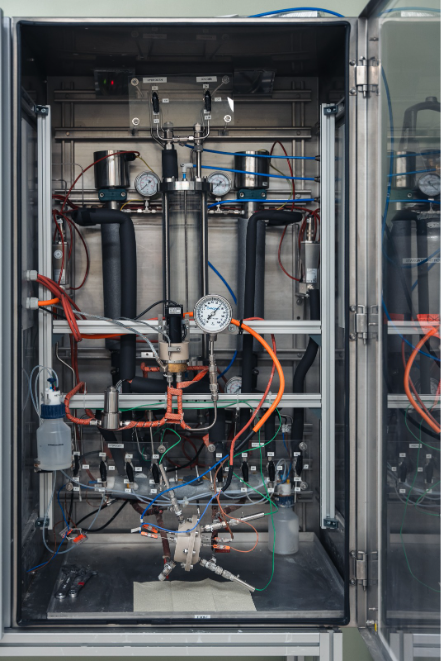
It allows electrode testing up to 20 cm² at current densities of up to 1 A per cm². The strength of Kalev lies in its accuracy and representativeness. The limitation is speed. With only one channel, testing throughput is low, making it unsuitable for rapid screening or parallel experiments. Still, Kalev laid the foundation for everything that followed.
Durga, Speed Through Parallelisation
To overcome throughput limits, Stargate Hydrogen developed Durga, a multi-channel single-cell testing unit. Durga can run eight tests simultaneously, operating continuously throughout the day and night.
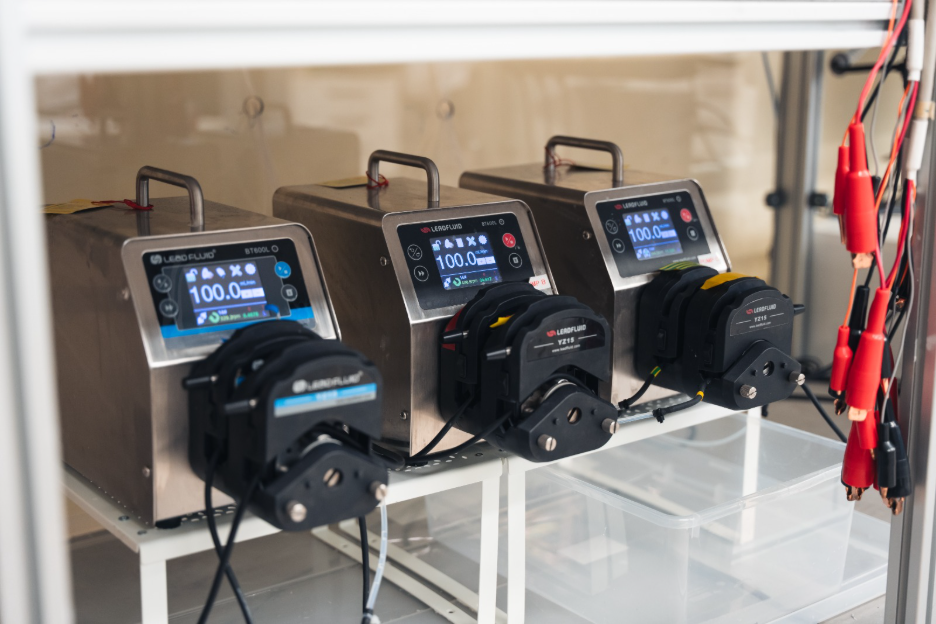
This increased testing capacity dramatically, allowing faster comparison of materials, coatings, and operating conditions. In July 2025, Durga supported a 1300-hour continuous test, a milestone that marked a new level of internal testing maturity for the company. Durga is now a core tool for rapid iteration and comparative studies.
Kraken, single-cell electrolyser stack testing to the next level.
At the time of this article, single-cell testing is still the best way to do initial characterisation, and although Durga is a well-developed platform, the team has been hard at work on improving almost every aspect of the platform. We call it Kraken.

For the time being, we don’t yet have an image of the Kraken testing system, which is still under construction. Its name is inspired by the legendary giant sea monster from Scandinavian folklore, often depicted as a massive cephalopod with enormous tentacles capable of dragging ships into the depths of the ocean. Much like the mythical Kraken, traditionally portrayed with eight arms, this testing system is designed to simultaneously test multiple cells.
Kraken represents Durga 2.0 with a seriously better control system, better single-component characterisation, and better modularity. All of this is to bring single-cell testing to the next level.
Starbench, Short Electrolyser Stack Testing Under Industrial Conditions
The most recent addition to Stargate Hydrogen’s testing capabilities is Starbench. This short-stack test bench can handle stacks of up to 15 cells and produce up to 5.5 cubic meters of hydrogen per hour. Starbench stands for Stargate Hydrogen’s move into full-stack-level testing. Designed as a next-generation platform, it allows the company to evaluate how individual components perform once integrated into a complete system. This transition is critical. Many effects only become visible at the stack level, and assumptions based on single-cell data do not always hold true once the system scales.
Starbench is built as a simplified version of a commercial electrolyser, using an industrial-grade PLC control system. It can run unattended overnight, making long-duration tests practical and cost-effective.
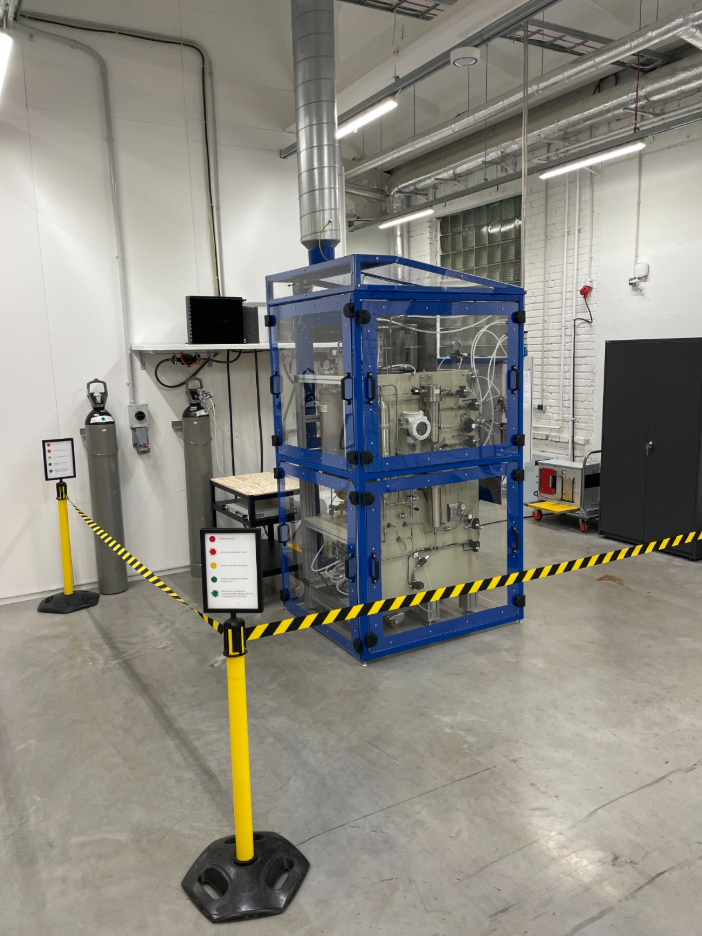
The Starbench plays a key role in validating electrodes produced on the new Stardust coating line before they are integrated into larger systems.
Current Limits and What Comes Next
Despite these advances, some limitations remain. Stargate Hydrogen cannot yet internally test large electrodes, such as the full 5 MW Starbase stacks. The next step is clear: designing and building a large-scale electrolyser stack testing platform capable of handling large-scale products at full size. This will extend the same philosophy that guided Kalev, Durga, Kraken, and Starbench into the next phase of growth.
By investing early in internal testing, Stargate Hydrogen has built a foundation that supports faster learning, better engineering decisions, and more reliable systems. It allows the company to move quickly without cutting corners and to scale without losing control of quality.
If you are looking for reliable and robust electrolysers Systems and Stacks, our team is ready to support you. Get in touch with Stargate Hydrogen and learn how our electrolysers enable you to produce green hydrogen with minimal risk and with high confidence, without compromising performance.